

The federation’s largest island offers extensive potential to investors in a diverse range of economic sectors, with investment-ready projects available in green energy and agritech
Home to over two-thirds of the country’s total population, the island of St.Kitts has experienced strong growth in foreign direct investments in recent years and that is forecast to continue as the government implements its strategy to transform the nation into a sustainable island state.
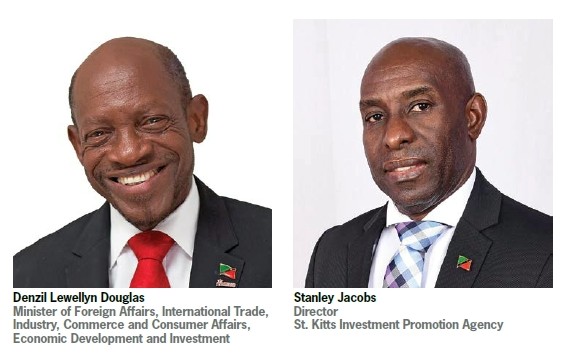
Among the investors set to benefit from the emerging opportunities on the island are entities from the US, a country that Denzil Lewellyn Douglas, Minister of Foreign Affairs, International Trade, Industry, Commerce and Consumer Affairs, Economic Development and Investment, describes as one of the nation’s most robust partners. “We’ve enjoyed diplomatic relations with the US since 1983, when we attained independence from the UK. This has been reinforced by America’s growing relations with the Caribbean Community and the Organization of Eastern Caribbean States economic union, which we are members of,” he says.
Douglas hopes that last year’s appointment of Roger Nyhus as US Ambassador to the Eastern Caribbean region will act as a catalyst for strengthening private-sector trade and investment connections between the two nations: “The goals and priorities he has outlined align and complement my ministry’s work program in terms of enhancing our manufacturing sector, bolstering trade between the US and St. Kitts and Nevis, addressing supply chain shortages, facilitating technology transfer and attracting investments through strategic partnerships.”
US businesses investing in the island have two advantages over investors from other countries. One concerns the US-Caribbean Partnership to Address the Climate Crisis 2030 agreement, through which the Biden administration is promoting investment from the US into Caribbean clean-energy projects. The other, according to Stanley Jacobs, Director of the St. Kitts Investment Promotion Agency (SKIPA), is that St. Kitts and Nevis is a partner in the Caribbean Basin Initiative. “This trade arrangement with the US allows US companies in St. Kitts and Nevis to re-export finished products to the US without attracting duty, which is beneficial for industries that want to relocate manufacturing,” he says. “This agreement has been very successful and we’re currently seeing renewed interest from companies that want to focus on high-value-added products, such as electronics, cell phones, laptops and computers.”
While both these agreements also apply to other countries in the region, St. Kitts stands out as an investment destination in a number of ways. “We’re the region’s financial capital and home to
the Eastern Caribbean Central Bank, we have an easily trainable workforce and an increasing number of direct flights to key international destinations,” states Jacobs. Further attractions include a strategic location near to the US and major maritime routes; its modern infrastructure; and the fact that it is a democratic English-speaking country, which complies with international standards and follows UK law. “We also have a stable government, a stable economy, a stable currency that is pegged to the US dollar, a stable investment climate and an investment-friendly government, which provides tax incentives for investors.”
SKIPA’s role is to make doing business easier for those investors. Responsible both for attracting FDI and supporting the expansion of investment projects, the government agency is the one-stop for investors in St. Kitts. As Jacobs puts it: “Essentially, we perform a hand-holding operation by navigating bureaucracy on investors’ behalf.”
In recent years, tourism and real estate have been sectors of particular interest to investors, according to Jacobs. “A significant amount of investment will continue to be concentrated in those sectors, with the ongoing construction of luxury- hotel developments, villas and condominiums. St. Kitts as a tourist destination is seen as fresh and investors tend to want to explore opportunities in newly emerging destinations,” he explains. “However, we believe our country is ripe for sustainable investments — for example, in solar, wind and geothermal energy and also in agriculture. As we move toward creating a sustainable island state, we want to focus our investment promotion strategy on areas that will help us achieve our United Nations sustainable development goals, food security being one and affordable green energy another.”
For that reason, SKIPA is now developing investment-ready proposals in those industries for potential investors, states Jacobs: “We’ve done a lot of work in agriculture. St. Kitts is small, with limited land for agricultural development. By utilizing greenhouse farming, plus smart nutrition and watering technologies, we could produce more crops using less land. To help channel investments into this sector, we’re packaging investment opportunities in agritech and in the build-out of the government’s Greenhouse Village project. We’re also creating similar investment-ready opportunities for renewable-energy projects.”
Other sectors with excellent prospects for investors include specialized medical tourism, financial services and information technology. “We’ve also been very successful in attracting international offshore educational institutions. Currently, we have four universities, with a student population of about 4,100, and we think there’s room for more accredited institutions,” he says.
Jacobs’ message to potential investors is that St. Kitts is open for business: “We invite you to contact SKIPA and learn about the array of globally competitive opportunities that are available. Not only do we invite you to invest, we also invite you to visit and to experience the hospitality and friendliness of our people and our culture. I’m sure that, having experienced the warmth and beauty of St. Kitts and Nevis, you will agree that this is the right place to invest.”